



Angola CNCA / ARCCLA Certificate

Shipping cargo to Angola requires a valid CNCA Certificate (Conselho Nacional de Carregadores de Angola), also known as ARCCLA. This document is mandatory for most shipments entering Angola and must be validated before cargo arrival.

Without a valid CNCA / ARCCLA certificate, shipments may face customs delays, penalties, or additional clearance procedures at the port.

We assist exporters, freight forwarders, and logistics companies in obtaining the Angola CNCA Certificate quickly and accurately. Our team reviews shipment documents, prepares the application, and ensures the certificate is issued before the cargo reaches Angola.

Submit your shipment details to begin the CNCA validation process.

ISO 9001 Certified by SGS

    What is the Angola CNCA / ARCCLA Certificate?​

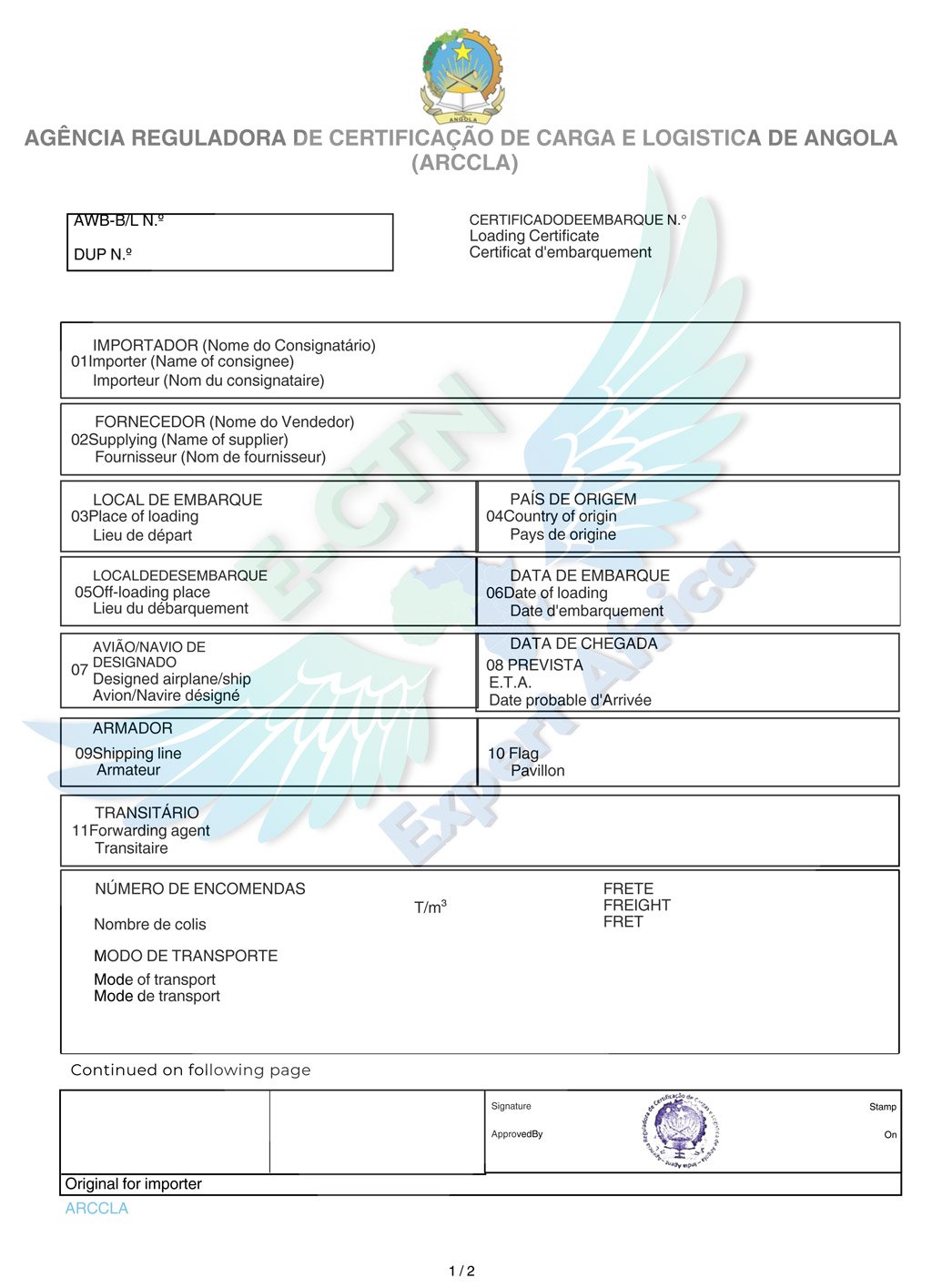
    The CNCA Certificate is a mandatory cargo tracking document required for shipments entering Angola.

    CNCA stands for Conselho Nacional de Carregadores de Angola, while ARCCLA refers to the regulatory authority responsible for cargo control.

    The certificate is used to monitor cargo shipments and verify shipment details before arrival in Angola.

    The CNCA certificate includes:

    • Bill of Lading details
    • Exporter and importer information
    • Cargo description and quantity
    • Freight charges and shipment value
    • Port of loading and discharge
    • Vessel and shipping route information

    Once issued, the CNCA reference number must be included in shipping documents to ensure smooth customs clearance.

    The CNCA certificate is required for most cargo shipments entering Angola.

    This applies to:

    • Exporters shipping goods to Angola
    • Freight forwarders handling cargo movement
    • Logistics companies managing international shipments
    • Shipping agents responsible for documentation

    Obtaining the certificate before cargo arrival helps prevent delays during customs clearance.

    To apply for the CNCA certificate, exporters must provide shipment documents for verification.

    Commonly required documents include:

    • Bill of Lading (Draft or Final)
    • Commercial Invoice
    • Freight Invoice
    • DU (Documento Único / Import License)

    All shipment information must match across documents. Any mismatch in cargo value, freight charges, or consignee details may delay validation.

    Our team reviews documents before submission to ensure accuracy.

    How to Obtain a Angola CNCA / ARCCLA?

    Submit your Bill of Lading, invoices, and documents for review—once approved, you’ll receive the validated ECTN for inclusion in your shipping paperwork.

    Submit Required Documents

    Provide the Bill of Lading, Commercial Invoice, Freight Invoice, and other supporting documents.

    Processing & Validation

    Your application will be reviewed, and any missing details will be requested.

    ECTN Issuance

    Once approved, you’ll receive the validated ECTN, which must be included in shipping documents.

    Angola CNCA Processing Time

    CNCA certificates are typically issued within 24–48 hours after document submission, depending on the accuracy of shipment details.

    Processing time may vary based on:

    • document completeness
    • verification requirements
    • shipment details

    Submitting documents early helps ensure timely validation before cargo arrival.

    Why Angola Requires CNCA Certificate

    The CNCA system helps authorities monitor cargo shipments entering Angola.

    It is used to:

    • improve cargo tracking and transparency
    • verify shipment documentation before arrival
    • prevent discrepancies in freight declarations
    • support customs compliance procedures

    This allows authorities to review shipment information in advance.

    What Happens if Cargo Arrives Without a CNCA Certificate?

    Shipping cargo without a valid CNCA certificate may lead to complications.

    Possible consequences include:

    • customs clearance delays
    • financial penalties
    • additional documentation procedures
    • administrative charges

    Exporters should obtain the certificate before shipment arrival to avoid these issues.

    0 +
    Certificates Validated

    ISO 9001 SGS Certified

    100 +
    Satisfied clients

    24/7 Support

    Ready to Get Your ECTN Certificate?​

    If you are shipping cargo to Angola, ensure your CNCA certificate is issued before the shipment arrives.

    Submit your shipment documents and our team will begin the validation process.

    Contact us today to start your Angola CNCA / ARCCLA Certificate application.

    Common Mistakes That Delay CNCA Validation

    Errors in shipment documents can delay the CNCA approval process.

    Common issues include:

    Mismatch between Bill of Lading and invoice details
    All shipment information must be consistent.

    Incorrect cargo value or freight charges
    Financial details must match submitted invoices.

    Missing DU / Import License
    The Documento Único is required for CNCA validation.

    Late application submission
    Submitting too close to arrival may delay processing.

    Careful document review helps avoid these issues.

    Why Work With a CNCA Processing Partner?

    CNCA validation requires accurate documentation and correct application submission.

    Working with an experienced team helps ensure:

    • accurate document verification
    • faster certificate validation
    • reduced risk of shipment delays
    • compliance with Angola import regulations

    Our specialists support exporters and freight forwarders throughout the process.

    FAQs related to Angola CNCA Certificate

    Find quick answers to common questions about the ECTN certification process.

    Basically, it is the same document with different names.

    CNCA certificate (Conselho Nacional de Carregadores) is a Loading Certificate (LC) which is a compulsory document for all commercial shipments to Angola since 28/01/1994 (Decree no. 19/94).

    The D.U. document or Documento Unico, is an Import Licence in Angola. A DU document is compulsory for all CNCA applications from 10/02/2015. A DU document must be valid regarding the Expiry date on field 25e. This document’s expiry date is 60 days from the date of DU issuance.

    However, the Documento Unico or the Import Licence is exempt if a shipment will be cleared, at the destination, under a Temporary Regime. Another instance where the DU document is not an obligation is when the total FOB value is below 5000 USD.

    In a Temporary shipment, the exporter must submit a letter confirming the cargo is on the temporary expedition. In this expedition, a unique format of the DU number will be entered on the validated CNCA certificate.

    DU document is not required for Temporary cargo to Angola, but it must be specified as a Temporary Shipment in the invoice or BL.

    Angola is the only country whose authorities require the importer to provide the original hard copy CNCA certificate before releasing the cargo. Every other country that mandates inbound shipments to accompany waiver certificates only requires a copy of the certificate. However, if you don’t send the original certificate to the importer in Angola, they can not clear the goods.

    No, CNCA/ARCCLA is unique and reserved only for one shipment. Every shipment must have a validated CNCA/ARCCLA number.

    No. The CNCA certificate number does not have to be mentioned on the bill of lading.

    Yes. Angola is the only country whose authorities require the Importer to provide the original hard copy of the CNCA certificate before they can release the cargo.

    It depends on the country from which it was loaded. In certain cases, we can amend the certificate if the printout is not given to the courier.

    Yes. The Angolan authorities have no age restrictions on vehicles that can be imported into the country.

    Yes. Angola authorities do not have a restriction on the age of heavy-duty vehicles that can be shipped into the country.

    ECTN Experts is a trusted and authorized agent specializing in trade compliance documentation—providing fast, accurate, and hassle-free solutions for obtaining ECTN, ICTN, and CTN certificates. They aim to relieve exporters and freight forwarders of complex regulations so your cargo shipments stay on track.

    A hard copy of the CTN certificate is generally not required, as the entire process is completed online. Digital validation and electronic submission suffice for customs and regulatory purposes.

    A Bill of Lading (BoL) is a legal shipping document issued by the carrier to the shipper. It outlines the type, quantity, and destination of the cargo.

    A Commercial Invoice is an essential document for export and import clearance. It may also serve currency exchange purposes and is used by customs to calculate import duties and taxes.