



Democratic Republic of the Congo FERI Certificate

Shipping cargo to the Democratic Republic of the Congo (DRC) requires a valid FERI Certificate (Fiche Électronique de Renseignement à l’Importation). This document is mandatory for most shipments entering the country and must be validated before cargo arrival.

Without a valid FERI certificate, shipments may face customs delays, penalties, or refusal of entry clearance at the destination port.

We assist exporters, freight forwarders, and logistics companies in obtaining the DRC Congo FERI Certificate quickly and accurately. Our team verifies shipment documents, processes the FERI application, and ensures the certificate is issued before cargo arrival.

Submit your shipment details to begin the FERI validation process.

ISO 9001 Certified by SGS

    What is a DRC Congo FERI Certificate?

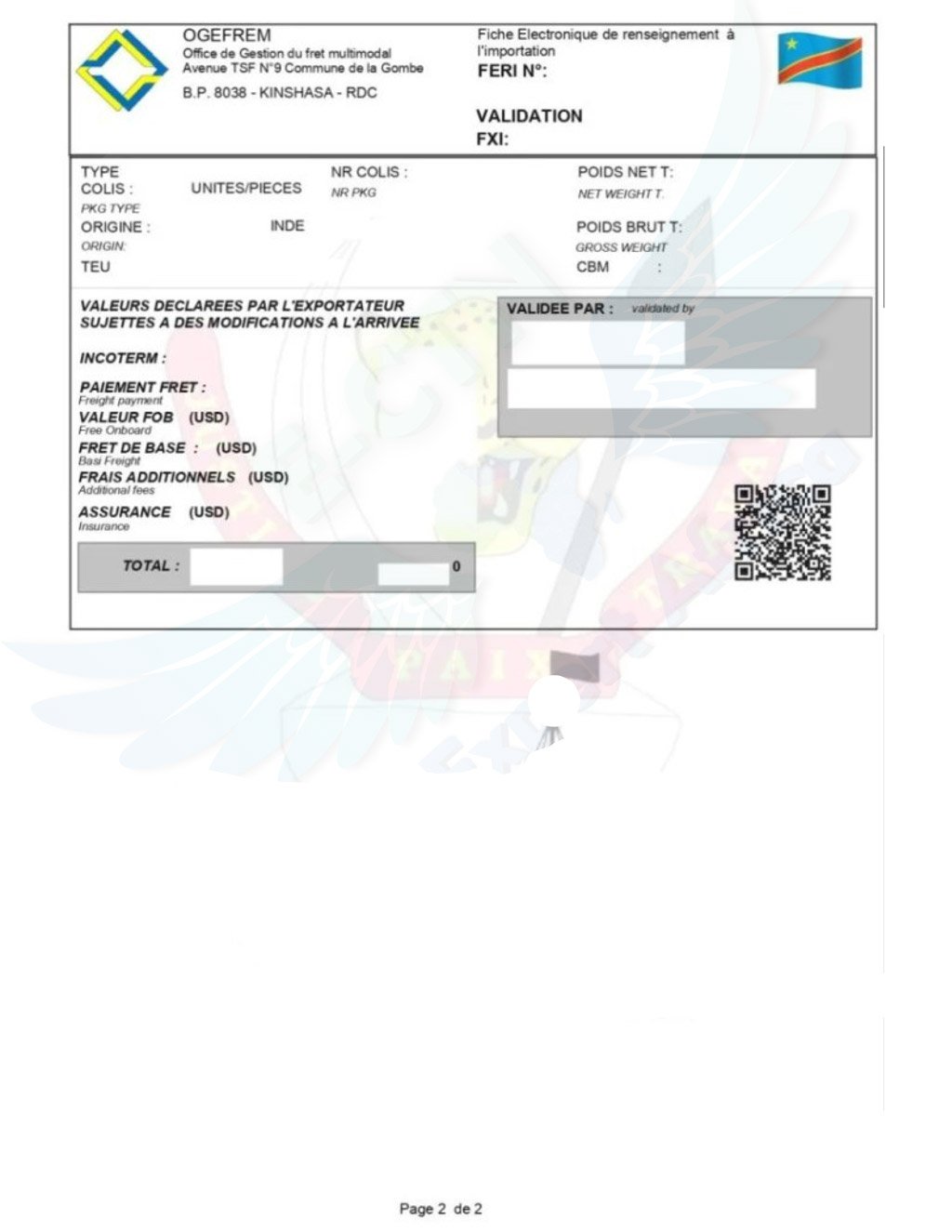
    The FERI Certificate (Fiche Électronique de Renseignement à l’Importation) is a mandatory cargo tracking document required for shipments entering the Democratic Republic of the Congo.

    It allows authorities to monitor incoming cargo and verify shipment details before arrival.

    The FERI certificate includes key shipment information such as:

    • Bill of Lading details

    • Exporter and importer information

    • Cargo description and quantity

    • Freight charges and shipment value

    • Port of loading and port of discharge

    • Vessel and shipping route details

    Once issued, the FERI reference number must be included in shipping documents to ensure smooth customs clearance.

    The FERI certificate is required for most cargo shipments entering the Democratic Republic of the Congo.

    This includes:

    • Exporters shipping goods to DRC

    • Freight forwarders handling international shipments

    • Logistics companies managing cargo transportation

    • Shipping agents responsible for export documentation

    Obtaining the FERI certificate before cargo arrival helps prevent delays during customs clearance.

    To successfully obtain a FERI certificate for DR Congo, exporters must provide accurate and consistent documentation. Any mismatch between documents can lead to delays or rejection.

    1. Bill of Lading (B/L)

    • Draft copy is accepted for initial submission
    • Final B/L is required before certificate validation
    • Must match consignee and cargo details

    2. Commercial Invoice

    • Must include cargo value and currency ($ or €)
    • Details should align with the Bill of Lading
    • Incorrect values may lead to customs issues

    3. Freight Invoice (if applicable)

    • Required only if freight charges are not mentioned in the commercial invoice
    • Must reflect the same currency

    4. Export Customs Declaration / Shipping Bill

    • Proof of export clearance from origin country
    • Required for validation

    5. Consignee Details

    • Full name, address, phone number, and email ID
    • Must match across all documents

    6. FSI / FXI Number

    • Provided by the importer (consignee)
    • Mandatory for processing FERI certificate

    Submitting clear and error-free documents ensures faster approval and avoids unnecessary corrections.

    How to Obtain a DRC Congo FERI?

    The FERI application process involves document verification and certificate validation.

    Submit Required Documents

    Provide the required shipment documents such as the Bill of Lading, Commercial Invoice, and Packing List.

    Processing & Validation

    The submitted documents are checked for accuracy, and a draft FERI certificate is generated. Exporter or shipper reviews the draft certificate and confirms correctness.

    FERI Certificate Issuance

    Once the shipment is finalized, the final B/L copy is submitted.After approval, the official FERI certificate is issued and validated for shipment clearance.Timely submission and accurate documentation can significantly reduce processing delays.

    DRC Congo FERI Processing Time

    FERI certificates are typically issued within 24–48 hours after document submission, depending on the accuracy of shipment details.

    Processing time may vary based on:

    • document completeness

    • verification requirements

    • vessel departure schedule

    Submitting documents early helps ensure timely validation before cargo arrival.

    FERI Certificate Cost for DR Congo

    The cost of a FERI certificate for the Democratic Republic of Congo is not fixed and depends on multiple shipment-related factors. Understanding these variables helps avoid unexpected charges during the application process.

    Key factors affecting FERI cost include:

    • Type of shipment (FCL, LCL, or bulk cargo)
    • Cargo value and nature of goods
    • Port of discharge (Matadi, Boma, Banana)
    • Shipping line and freight charges
    • Urgency of processing

    In most cases, the FERI certificate cost ranges between $100 to $300+, depending on the complexity of the shipment and documentation accuracy.

    It is always recommended to apply early and submit accurate documents to avoid additional amendment or penalty charges.

    Why the Democratic Republic of the Congo Requires FERI

    The FERI system helps authorities monitor cargo entering the country and verify shipment information before arrival.

    It is used to:

    • improve cargo tracking and transparency

    • verify freight declarations

    • prevent discrepancies in shipment data

    • support customs compliance procedures

    This allows authorities to review shipment details in advance.

    What Happens if Cargo Arrives Without a FERI Certificate?

    Shipping cargo without a valid FERI certificate may lead to serious complications.

    Possible consequences include:

    • customs clearance delays

    • financial penalties

    • refusal of entry clearance

    • additional administrative procedures

    Exporters are advised to obtain the FERI certificate before cargo arrival to avoid these issues.

    0 +
    Certificates Validated

    ISO 9001 SGS Certified

    100 +
    Satisfied clients

    24/7 Support

    Ready to Apply for Your DRC Congo FERI Certificate?

    If you are shipping cargo to the Democratic Republic of the Congo, ensure your FERI certificate is issued before the shipment arrives.

    Submit your shipment documents and our team will begin the validation process.

    Contact us today to start your DRC Congo FERI Certificate application.

    FERI Certificate Requirements for Major DR Congo Ports

    FERI certificate is mandatory for all major ports in the Democratic Republic of Congo. While the process remains the same, shipments are commonly routed through the following ports:

    Matadi Port

    • Primary and busiest port in DR Congo
    • Most shipments require strict FERI compliance

    Boma Port

    • Used for specific cargo shipments
    • FERI required before cargo arrival

    Banana Port

    • Strategic port for international trade
    • FERI certificate mandatory for customs clearance

    Exporters must ensure the FERI certificate is issued before vessel arrival at any of these ports to avoid penalties or shipment delays.

    Common Mistakes That Delay FERI Validation

    FERI applications may be delayed if shipment details are incorrect or inconsistent.

    Common issues include:

    Mismatch between Bill of Lading and invoice details
    Cargo description, container details, and consignee information must match across documents.

    Incorrect cargo value or freight charges
    All financial details must be consistent across invoices and application data.

    Missing or incorrect FXI number
    In some cases, the importer must provide the correct FXI number for validation.

    Late application submission
    Submitting the FERI request too close to arrival may delay processing.

    Careful document review helps reduce these issues.

    Example: FERI Certificate for Shipment from India to Matadi

    For a typical shipment from India to Matadi port, the exporter must first prepare all required documents, including the commercial invoice and Bill of Lading.

    Once submitted, the FERI application is processed within 24–48 hours. After draft approval and final document submission, the certificate is issued before the vessel arrives in DR Congo.

    Any delay in applying for the FERI certificate may result in penalties or cargo being held at the port.

    Why Work With a FERI Processing Partner?

    FERI validation requires accurate documentation and correct application submission.

    Working with an experienced processing team helps ensure:

    • accurate shipment document verification

    • faster certificate validation

    • reduced risk of shipment delays

    • compliance with DRC import regulations

    Our team supports exporters and freight forwarders throughout the process.

    FAQs related to the Democratic Republic of Congo FERI Certificate

    Find quick answers to common questions about the DRC Congo FERI certification process.

    It is another name for a waiver document. It stands for Fiche Électronique des Renseignements a l’Importation.

    Yes. There is no restriction in terms of exporting tea into DR Congo. We can provide your FERI certificate if you have the required documents.

    They are both the same kind of waiver certificate. Just different country authorities call it their own way. FERI is a certificate name given by DR Congo authorities for the waiver they require from each sea shipment.

    Yes, they are two different countries, and their system is different.

    FXI is a unique number found on the GICHE document. It is mandatory when applying for the Democratic Republic of Congo FERI certificate. Exporters shipping to D.R. Congo must ask their importer to obtain the GICHE document.

    No, FERI is unique and reserved only for one shipment. Every shipment must have a validated FERI number.

    Yes, any party involved in the export process can apply for a FERI certificate, provided they can submit the required documents via email.

    ECTN Experts is a trusted and authorized agent specializing in trade compliance documentation—providing fast, accurate, and hassle-free solutions for obtaining ECTN, ICTN, and CTN certificates. They aim to relieve exporters and freight forwarders of complex regulations so your cargo shipments stay on track.

    The hard copy of the certificate isn’t necessary at all. Instead, the whole process is completed online.

    A Bill of Lading (BL or BoL) is a legal document issued by a carrier to a shipper that specifies the type, quantity, and destination of the goods being transported. It serves as a receipt of shipment, a document of title, and a contract between the shipper and the carrier.

    A commercial invoice is a mandatory document for the export and import clearance process. It is sometimes used for foreign exchange control purposes. In the buyer’s country, customs officials rely on the commercial invoice to assess applicable import duties and taxes.